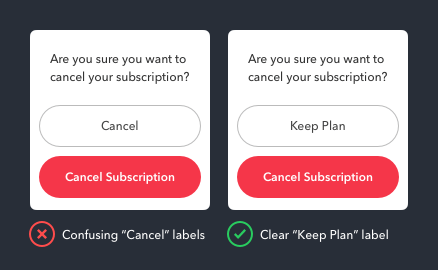
Cancel buttons sometimes have different names. “Not Now” and “Maybe Later” are some dismissive labels one could use. But there’s one case when the Cancel button should not say “Cancel” nor use a dismissive label. This is when the main call to action is destructive.
For example, a confirmation screen for canceling a subscription service has a destructive call to action button labeled “Cancel Subscription.” Placing this button next to a Cancel button is confusing and can cause users to cancel their subscription by accident.
Replacing “Cancel” with a dismissive label such as “Not Now” or “Maybe Later” is also confusing. These labels imply that users don’t want to cancel their subscription now, but will later. This isn’t clear and doesn’t feel safe to press.
To make users feel safe, the Cancel button should have a label that’s the opposite of canceling so users can tell them apart. Here, the opposite of canceling a subscription is keeping it.
A “Keep Plan” label communicates a clear action that feels safe to press. When users signed up, they had to choose a subscription plan. The word “Plan” reminds them of their beginnings they’re familiar with.
Also, labels shouldn't compete. When the same words are used on both button labels, users can mistake one button for the other. Similar labels require users to read carefully, which they don’t always do.
What makes users feel safe is a label with a positive connotation for the Cancel button, such as “Keep Plan.” It’s the best label to use because it creates a strong contrast between the safe and destructive action via look and feel.
Some may think it’s better to use “Unsubscribe” instead of “Cancel Subscription” for the label, but this is a mistake. “Subscription” and “subscribe” aren’t interchangeable labels because they imply different contexts.

➡️The act of subscribing applies to publications where users receive content regularly through a feed or channel. For example, online magazines and video channels, such as the Wall Street Journal and YouTube, ask users to subscribe because they publish their own content and deliver it to them on a regular basis.