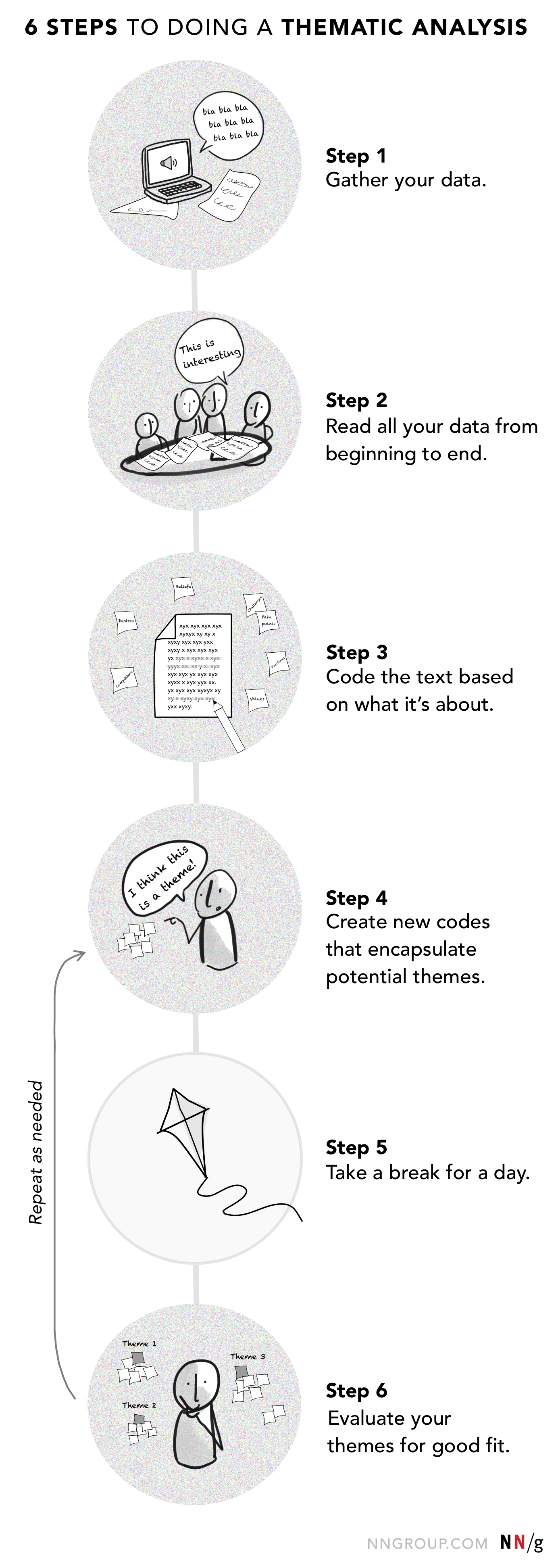
Regardless of which tool you use (software, journaling, or affinity diagraming), the act of conducting a thematic analysis can be broken down into 6 steps.
A thematic analysis involves 6 different phases: gathering the data, reading all the data from beginning to end, coding the text based on what it’s about, creating new codes that encapsulate candidate themes, taking a break and coming back to the analysis later, and evaluating your themes for good fit.
Start with the raw data, such as interview or focus-group transcripts, field notes, or diary study entries. I recommended transcribing audio recordings from interviews and using the transcriptions for analysis instead of relying on patchy memory.
Familiarize yourself with the data before you begin the analysis, even if you were the one to perform the research. Read all your transcripts, field notes, and other data sources before analyzing them. At this step, you can involve your team in the project. Involving your team instills knowledge of users and empathy for them and their needs.
Run a workshop (or a series of workshops if your team is very large or you have a lot of data). Follow these steps:

A workshop where each team member reads each diary- or field-study entry and highlights important bits is a good way of getting team members to actively engage with the text, as opposed to just reading it and letting it wash over them.
While it’s best if your team observes all your research sessions, that may not be possible if you have a lot of sessions or a big team. When individual team members observe only a handful of sessions, they sometimes walk away with an incomplete understanding of the findings. The workshop can solve that problem, since everyone will read all the session transcripts.
In the coding step, highlighted sections need to be categorized so that the highlighted sections can be easily compared.
At this stage, remind yourself of your research objectives. Print your research questions out. Stick them up on a wall or on a whiteboard in the room where you’re conducting the analysis.